- Intellery
- Posts
- Microsoft Projects 230 Million AI-Powered Digital Jobs for Africa
Microsoft Projects 230 Million AI-Powered Digital Jobs for Africa
PLUS: Nigeria Launches AI-Government Training Program for Civil Servants

Ayodele Oluleye
October 24, 2025


Weekly Roundup
Hi Ayodele here,
This week, Africa’s AI story focused on empowerment and scale. Nigeria took a major step by launching a government-wide AI training program to strengthen public sector innovation. Leading telecom operators joined forces to build inclusive language models that reflect Africa’s linguistic diversity. And Microsoft’s new projections point to 230 million AI-driven digital jobs that could transform the continent’s workforce by 2030.
This edition explores how these initiatives are shaping a future where AI fuels skills, inclusion, and opportunity across Africa.
Let us get into it. In this edition:
Nigeria Launches AI-Government Training Program for Civil Servants
African Mobile Operators Unite to Advance Inclusive African AI
Microsoft Projects 230 Million AI-Powered Digital Jobs for Africa
Around Africa
Nigeria Launches AI-Government Training Program for Civil Servants
Nigeria, in partnership with Google and Apolitical, has introduced the AI Government Campus, a training program tailored for civil servants to build AI literacy, ethics, and application in governance. The initiative is designed with structured online modules covering practical AI uses and assessment components to track progress.
At its launch in Abuja, the Minister of Communications emphasized that AI is central to boosting productivity in sectors like education, food security, and healthcare. Google’s West Africa government affairs manager noted the company’s investment in providing tools and knowledge for smarter governance. Previous commitments from Google in Nigeria include a ₦2.8 billion investment into AI education and an upskilling pipeline training 20,000 Nigerians in data science and AI. The program complements the country’s broader efforts to integrate AI into public service and increase digital inclusion.
Why This Matters
This initiative helps ensure that governance in Nigeria becomes more agile and tech-enabled, equipping public institutions to harness AI effectively and responsibly.
African Mobile Operators Unite to Advance Inclusive African AI
The GSMA and leading African mobile operators, including MTN, Orange, Airtel, and Vodacom, launched a continent-wide collaboration to develop AI language models that reflect African languages, data, and contexts. The push under the banner “AI Language Models in Africa, By Africa, For Africa” aims to fill gaps in data, compute, talent, and policy that currently limit AI inclusion.
Over 2,000 languages are spoken across Africa, yet only a fraction are supported in mainstream AI systems, raising concerns about digital exclusion. The initiative will establish working groups to drive measurable progress, share outcomes, and mobilize regional leadership. Partners commit to using local data, supporting talent mobilization and ensuring cultural relevance in AI deployment. This step signals a shift toward greater digital sovereignty and contextualised AI development on the continent.
Why It Matters:
By prioritising African languages and local data, the collaboration strengthens the region’s ability to build AI systems that are inclusive, relevant and rooted in homegrown innovation.
Microsoft Projects 230 Million AI-Powered Digital Jobs for Africa
According to Microsoft, the African continent could unlock up to 230 million digital jobs by 2030 through AI and related technologies. The company points to Kenya’s AI Skilling Initiative as a replicable framework for government-industry collaboration, having trained thousands of public servants and professionals.
To realise this potential, countries must build coordinated, scalable training ecosystems spanning governments, industry and education. Industry-recognized certification and localized training programs are key to matching talent with job market demands. Microsoft emphasises connecting the informal economy through micro-entrepreneur networks and AI-skill pathways. The goal is to ensure AI adoption results not just in technology diffusion but sustainable jobs and inclusive economic growth.
Why This Matters
A coordinated approach to AI skilling across the continent can turn Africa’s youthful workforce into a competitive global asset, driving innovation, employment and future-proof economic participation.
Around the world
Snapchat Makes AI “Imagine Lens” Free for All US Users
Snapchat has opened access to its “Imagine Lens,” a text-prompt image generator, making it freely available to all users in the U.S. after previously limiting it to Lens+ and premium subscribers. The Lens lets users create or edit Snaps using prompts like “turn me into an alien” or “grumpy cat.” Users can share creations to their Story or beyond Snapchat. The move follows intensifying competition from OpenAI’s Sora and Meta’s AI tools in the visual generation space.
OpenAI’s “Atlas” Browser Centers ChatGPT Over Web
OpenAI introduced Atlas, a new browser built around ChatGPT rather than traditional web navigation. With Atlas, ChatGPT sits in a sidebar to help summarize pages, compare content, and complete tasks without switching tabs. The browser is available first on macOS, with Windows, iOS, and Android versions in development. OpenAI emphasizes that Atlas is more about advancing ChatGPT’s central role than reinventing web browsing.
Amazon Debuts AI Smart Glasses for Delivery Drivers
At its “Delivering the Future” event, Amazon revealed smart glasses for delivery drivers that provide turn-by-turn navigation, package scanning, and proof-of-delivery capture via a built-in display. The glasses activate after drivers park and pair with a vest controller containing battery and controls. Drivers wear them to reduce reliance on phones and improve safety on routes. Amazon is currently testing the devices with its North American delivery partners.
Around the Web - Top Picks
AI and Software Engineering: This Time It’s Different… It Never Is
Edem Kumodzi reflects on the recurring hype cycles in technology, from cloud computing to AI, and argues that while AI is reshaping software engineering, the underlying truths about building, maintaining, and scaling software remain the same. He explores how engineers can adapt to AI’s rise without losing sight of timeless principles like system design, clarity, and collaboration.
Read the full article: AI and Software Engineering: This Time It’s Different… It Never Is
Exploring the Operating Stack for Africa’s Tech Firms
A new report titled "The Operating Stack" analyzes how African startups can construct robust technology, talent, and data infrastructure to support sustainable growth. It outlines critical layers, from foundational infrastructure like cloud and connectivity to higher layers like product, operations, and partnerships tailored for African markets. It frames the operating stack as a strategic lens for African companies to translate innovation into scale.
Read the full article: Exploring the Operating Stack for Africa’s Tech Firms
Seen This?
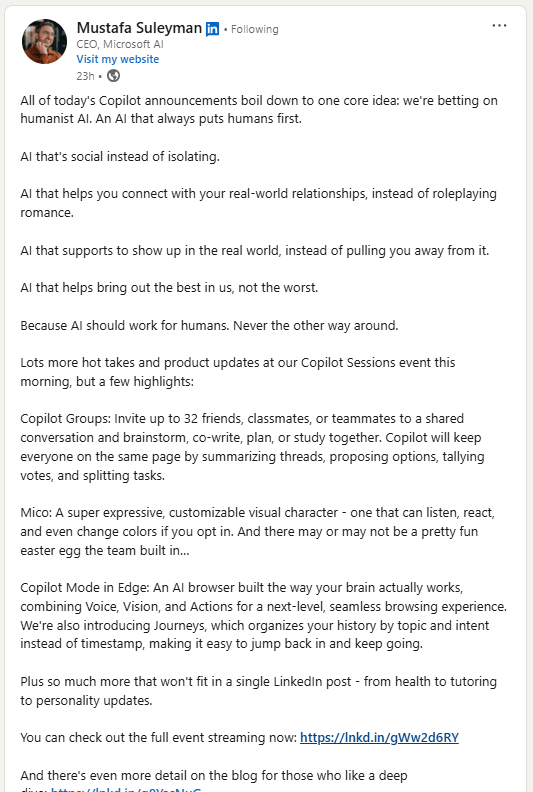
Microsoft’s Copilot just got a massive upgrade. The new version comes with memory, meaning it can now remember things about you (only if you let it) and use that to personalize conversations. Mustafa Suleyman’s demo showed how seamlessly it connects across apps like Gmail, OneDrive, and Outlook, helping you plan your day, summarize emails, and even manage tasks automatically.
Upcoming African AI Events
AI Expo Africa 2025
Date: October 29–31, 2025
Location: Johannesburg, South Africa
Theme: The 8th edition of Africa’s largest B2B AI trade show, bringing together over 3,000 delegates, 100+ exhibitors, and 70+ conference sessions. The event features Women in AI and South African AI Association pavilions, startup zones, and networking opportunities connecting buyers and suppliers in the AI market.
AI for Good – Impact Africa
Date: October 31, 2025
Location: Johannesburg, South Africa
Theme: A one-day UN-backed summit under the AI for Good initiative, focused on AI-driven solutions for sustainable development across Africa. Discussions will center on AI applications in health, agriculture, climate, and education, highlighting the role of technology in achieving UN Sustainable Development Goals.
Africa Tech Festival & AI Summit Cape Town 2025
Date: November 11–13, 2025
Location: CTICC, Cape Town, South Africa
Theme: Formerly known as AfricaCom, this 28th annual festival unites over 12,000 attendees across telecoms, innovation, and digital transformation. The AI Summit Cape Town track will explore governance, infrastructure, and ethical AI, alongside special features like the AI4Good Impact Africa Pavilion.
Africa Forum on AI and Gender
Date: November 4, 2025
Location: Hosted by UNESCO and partners (virtual and in-person hubs across Africa)
Theme: Ensuring diversity and ethics in AI development, this forum brings together policymakers, researchers, and organizations to promote gender balance in AI leadership and responsible innovation across Africa.
IndabaX AI Workshops and Hackathons
Date: November 2025
Location: Various African countries (Uganda, Ghana, Zimbabwe)
Theme: Community-led events affiliated with the Deep Learning Indaba, aimed at spreading practical AI skills at the grassroots. These workshops and hackathons foster local innovation and strengthen Africa’s AI talent pipeline.
NeurIPS 2025 – Black in AI Workshop
Date: December 2025
Location: Global (with African researchers’ participation)
Theme: Highlighting Africa’s growing presence on the global AI research stage, the Black in AI workshop at NeurIPS 2025 provides a platform for African scholars to present research, network with peers, and advance inclusive AI innovation.
AI Job Opportunities
Moniepoint Group - Data Engineer, Nigeria
IBM - Research Intern, South Africa
Spur Corporation - Data Analyst Intern, South Africa
KiaKia Finance - Data Scientist, Nigeria
AfriESG - Data Analyst, Ethiopia
Use Case: Workflow Automation with n8n
In today’s world where businesses rely on countless apps, platforms, and services, managing workflows manually is time-consuming and error-prone. This is where n8n comes in.

n8n is an open-source workflow automation tool that connects different applications through triggers and actions, allowing teams to automate repetitive tasks without heavy coding. From syncing customer data across CRMs, to auto-sending notifications when files update, to integrating AI models into existing processes, n8n makes complex workflows seamless. It empowers businesses to scale operations efficiently while keeping control and flexibility since it can be self-hosted and customized.
Learn how to use here
Reply